Spring-Loaded Connector vs. Pogo Pin: Is There a Difference?

If you have ever browsed a connector catalogue, you have probably seen the same component described two different ways on two different pages. One supplier calls it a pogo pin. Another calls it a spring-loaded connector. A third calls it a spring contact probe, a spring pin, or a spring-loaded contact.
So which is correct? And more importantly — when you send a drawing to a supplier, does the word you choose change what lands on your desk?
The two terms overlap almost entirely, but they are not perfectly interchangeable. There is a real distinction, and it starts to matter the moment you move from browsing to specifying. This guide covers the terminology, the mechanics, the specifications that genuinely differ, and how to choose the right part for your product.
The short answer: a pogo pin is the individual spring-loaded contact — one plunger, one barrel, one spring. A spring-loaded connector is the finished assembly, with several of those pins held in a housing and ready to mount. Same technology, different level of integration. In everyday use, most engineers treat the two as synonyms.
Same Technology, Different Scope
Both terms describe one mechanism: a plunger pushed outward by an internal helical spring, riding inside a machined barrel, pressing against a flat pad or target.
The difference is scope. Think of it the way you would think about a resistor versus a resistor network — identical physics, different packaging. A bare pin gives you total freedom over layout and pitch because you build the mount yourself. A housed connector gives you a fixed pitch, a defined mounting footprint and plug-and-play repeatability.
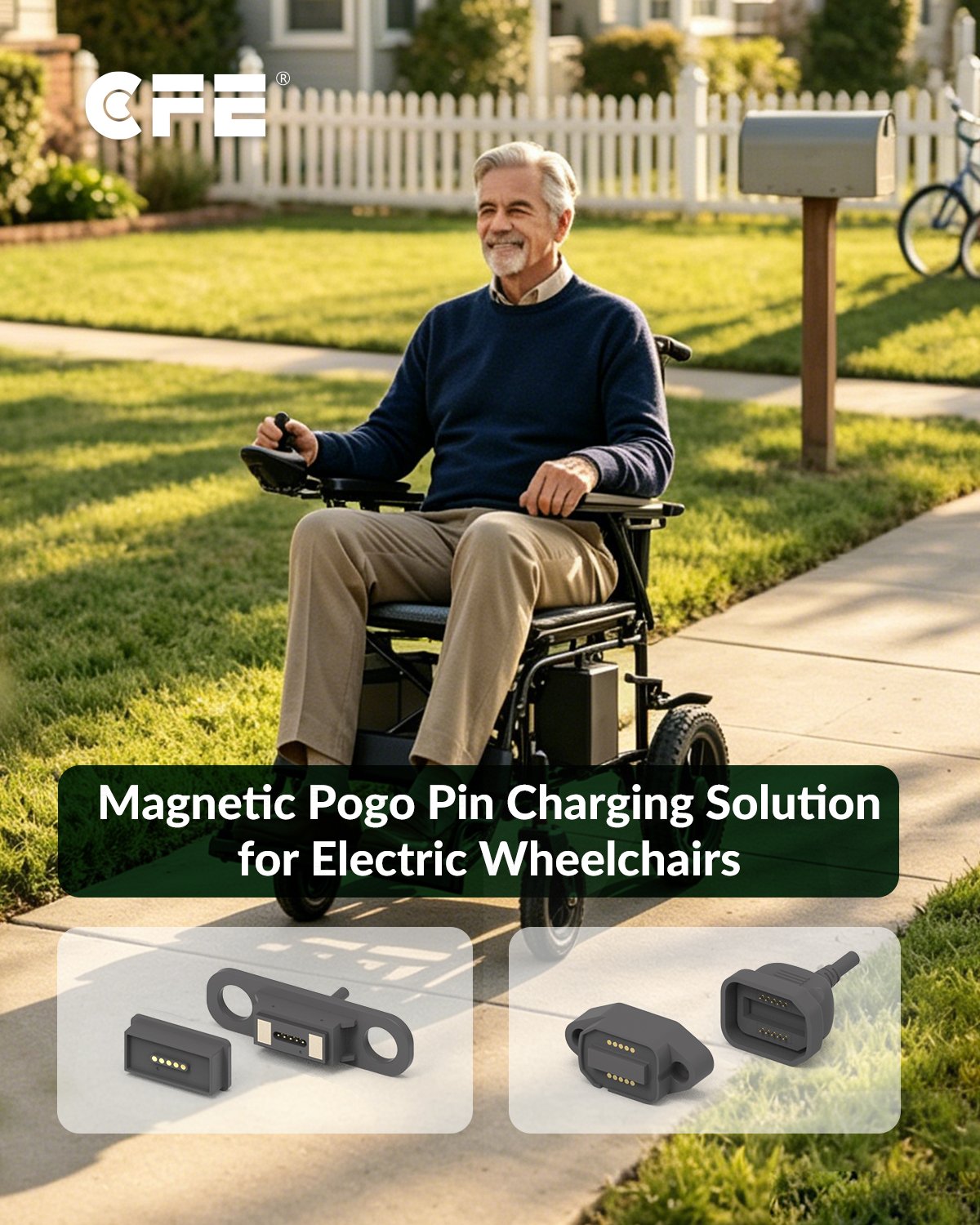
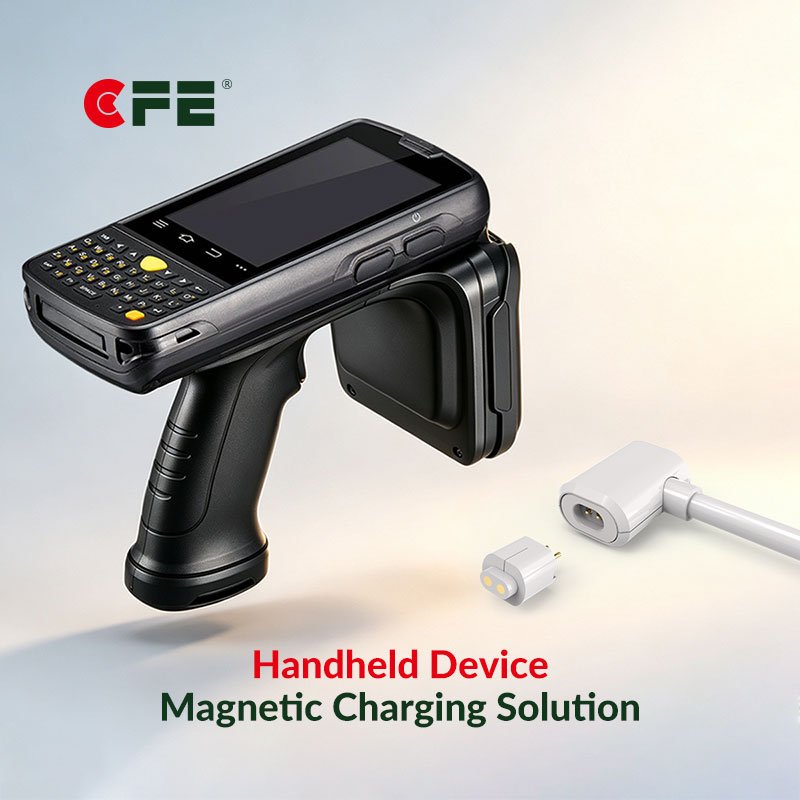
Common usage has blurred the line almost completely. Most suppliers, including most catalogues, use “pogo pin connector” and “spring-loaded connector” as exact synonyms for a multi-pin assembly, and nobody will misunderstand you either way. CFE’s pogo pin connector range lists single pins and complete assemblies side by side for exactly this reason.
Where the Name “Pogo Pin” Comes From
The name is descriptive. The plunger bounces in and out of the barrel much like a person on a pogo stick, which is precisely what the helical spring inside makes it do.
There is a trademark wrinkle worth knowing. According to the reference entry on pogo pins, the phrase is a registered trademark of Everett Charles Technologies, even though it has become a generic industry term through decades of casual use. That is one practical reason manufacturers, datasheets and RFQ templates often default to the more neutral “spring-loaded connector” or “spring contact probe” in formal documentation.
So if a quotation never once uses the phrase “pogo pin,” it is not because the supplier is offering something different. It is usually just careful language.
How a Spring-Loaded Connector Works
Whatever you call it, the mechanism is the same three-part arrangement. The plunger is the moving contact tip that touches the mating pad, typically brass or beryllium copper with gold plating over a nickel barrier. The barrel is the machined sleeve that guides the plunger and carries current. The spring — stainless steel or beryllium copper — supplies a constant normal force so the contact never floats.
What makes this arrangement so useful is that the spring absorbs tolerance. A rigid connector needs both halves to line up precisely. A spring-loaded connector only needs the pad to be larger than the plunger tip and within the pin’s working stroke. Board warpage, assembly stack-up, thermal expansion and everyday user misalignment get soaked up by the spring instead of turning into an intermittent connection.
Most pogo pins use a helical spring, which is unusual — the majority of connector families rely on cantilever springs or expansion sleeves. The helical design is what delivers consistent force across the full compression range and keeps contact resistance stable over tens of thousands of cycles.

Pogo Pin vs. Spring-Loaded Connector: Side by Side
| Aspect | Pogo Pin (Spring-Loaded Pin) | Spring-Loaded Connector |
|---|---|---|
| What it is | A single contact component | A complete multi-pin assembly |
| Housing | None — bare pin | Insulated or moulded housing included |
| Typical use | Test fixtures, custom layouts, probes | Charging docks, battery contacts, board-to-board |
| Mounting | Press-fit, solder cup, designer-supplied | SMT, DIP, right angle, screw mount |
| Pin count | One | 2 to 20+ |
| Pitch | Set by your own tooling | Fixed by housing — 2.0, 2.54, 4.0 mm typical |
| Lead time | Often shorter, off the shelf | Longer if custom-housed |
| Best when | You need maximum layout freedom | You need plug-and-play reliability |
The Six Specifications That Actually Decide the Part
Once the terminology is settled, these are the parameters that determine whether a connector works in your product or quietly fails in year two.
- Current rating (1–30 A). Standard pins handle 1–3 A comfortably. Charging docks, battery packs and tool changers need purpose-built high-current designs with reinforced barrels; specialised series reach 30 A.
- Spring force (50–200 gf). Measured at mid-compression. Too little and the contact chatters under vibration. Too much and you accelerate plating wear and make the dock unpleasant to separate.
- Working height, not free height. The dimension designers get wrong most often. Specify the compressed height in service and aim to sit near mid-stroke, so you keep travel in both directions.
- Plating thickness (3–30 µ″ gold). Thicker gold buys mating cycles and corrosion resistance. A wearable docked twice a day for five years needs far more gold than a fixture mated once a month.
- Mating cycle life (10,000–1,000,000). Depends on construction and plating. Ask for the test report, not just the catalogue figure — cycle life is measured, not calculated.
- Contact resistance (20–50 mΩ). Anything drifting higher under load shows up as heat and voltage drop. Watch the value after cycling, not only when new.
Add ingress protection to that list if the connector is exposed. Sealed versions using O-rings and press-fit assemblies are available up to IPX8, which covers sports wearables, outdoor sensors and washdown equipment.
Mounting Styles You Will See in Catalogues
The housing style is where most of the real product variation lives, and it is usually the first thing to fix in a design review.


Beyond these, you will find DIP and through-hole versions for stronger mechanical anchoring, solder-cup pins terminated straight to wire where no PCB exists, screw-mount bodies for industrial enclosures, and magnetic variants that self-align and break away safely. Drawings and full specifications for each configuration are on the spring-loaded connector product page.
Where These Connectors End Up


The common thread is a connection that must be made and broken repeatedly, survive shock and vibration, and occupy almost no space.
Which Term Should You Use in Your RFQ?
Practical advice: use both. Write “spring-loaded connector (pogo pin)” in your subject line and your drawing notes. It removes ambiguity, it matches how suppliers index their catalogues, and it makes sure your enquiry reaches the right engineer rather than the wrong product line.
Then let the specification carry the weight. A supplier does not need your vocabulary to be perfect. They need pin count and pitch, current per pin, working height and available stroke, required mating cycles, mounting style, and the environment the part will live in. Get those six right and the naming question stops mattering entirely.
Choosing a Manufacturer
Because these parts are precision-turned rather than stamped, small and medium volumes stay economical — you are not amortising a stamping die. That makes custom pin counts, pitches and housings far more accessible than in other connector families, often at quantities where a custom connector would normally be out of reach.
When evaluating a pogo pin manufacturer, look for in-house plating control, documented cycle-life and salt-spray testing, tooling capability for custom housings, and a willingness to prove current rating with real thermal data rather than a catalogue number.
Frequently Asked Questions
Is a pogo pin the same as a spring-loaded connector?
Essentially yes. “Pogo pin” usually refers to the individual spring-loaded contact, while “spring-loaded connector” refers to a complete assembly of several pins in a housing. In everyday industry use, the terms are treated as synonyms.
Why do some manufacturers avoid the term “pogo pin”?
It is a registered trademark, even though it is widely used generically. Manufacturers therefore prefer neutral terms such as spring-loaded connector or spring contact probe in formal documentation.
How much current can a spring-loaded connector carry?
Standard pins typically handle 1–3 A. Purpose-built high-current designs with reinforced barrels and enlarged contact areas can carry up to 30 A.
How long do pogo pin connectors last?
Depending on plating thickness and construction, ratings range from roughly 10,000 mating cycles for basic parts up to 1,000,000 cycles for premium designs.
Can spring-loaded connectors be waterproof?
Yes. Sealed versions with O-rings and press-fit assemblies are available up to IPX8, suitable for wearables, outdoor sensors and washdown environments.
What is the difference between working height and free height?
Free height is the uncompressed height of the pin. Working height is the compressed height in actual service. Always specify working height, because it determines contact force and reliability.
Are custom pogo pin connectors expensive?
Less than most people expect. Pins are machined rather than stamped, so there is no expensive mould, which makes custom pin counts, pitches and housings viable at moderate volumes.
Can pogo pin connectors carry data as well as power?
Yes. They are used for USB, I²C, UART and higher-speed signals. For high-frequency work, impedance-controlled layouts place ground pins around the signal pin.
Conclusion
So, spring-loaded connector versus pogo pin: is there a difference? Technically yes, practically almost none. A pogo pin is the individual spring-loaded contact; a spring-loaded connector is the housed assembly built from several of them. Beyond that, they describe identical technology — a plunger, a barrel, and a helical spring delivering constant contact force.
What separates one part from another is never the label. It is the specification: current rating, spring force, working height, plating thickness, cycle life and ingress protection. Those numbers decide whether a charging dock still works reliably after three years in a user’s pocket, or starts dropping the connection every time the device is nudged.
If you are specifying a connection for a wearable, a POS terminal, a medical device or an industrial dock, browse the full pogo pin connector and spring-loaded connector range and send your drawing for a design review.