Ask most buyers what matters in a pogo pin connector and they will say current rating, plating, and price. The plastic housing rarely makes the list. Then a batch comes back from reflow with warped bodies, or a sealed connector starts leaking after a humid summer, and the housing suddenly becomes the most important part on the bill of materials.
Two plastics dominate the conversation for demanding pogo pin housings: LCP (liquid crystal polymer) and high-temperature PA (polyamide, such as PA46, PA6T, or PA9T). They look similar on a drawing and behave very differently in a factory, in a sealed enclosure, and in the field. This guide compares them the way a buyer needs to, so you can write a clearer requirement before you request a quote for a waterproof 5A–30A pogo pin or magnetic connector.
Quick answers
- LCP wins on dimensional stability, very low moisture uptake, and thin-wall precision. It is the usual pick for fine-pitch, SMT, and tightly sealed designs.
- High-temp PA wins on toughness, weld-line strength, and cost. It suits larger housings and rougher handling, provided moisture is managed.
- Neither is “better” in general. The right choice depends on reflow, pitch, sealing method, and environment.
- Always confirm the exact resin grade in writing. “LCP” and “PA” each cover many materials.
Why the Housing Matters More Than It Looks
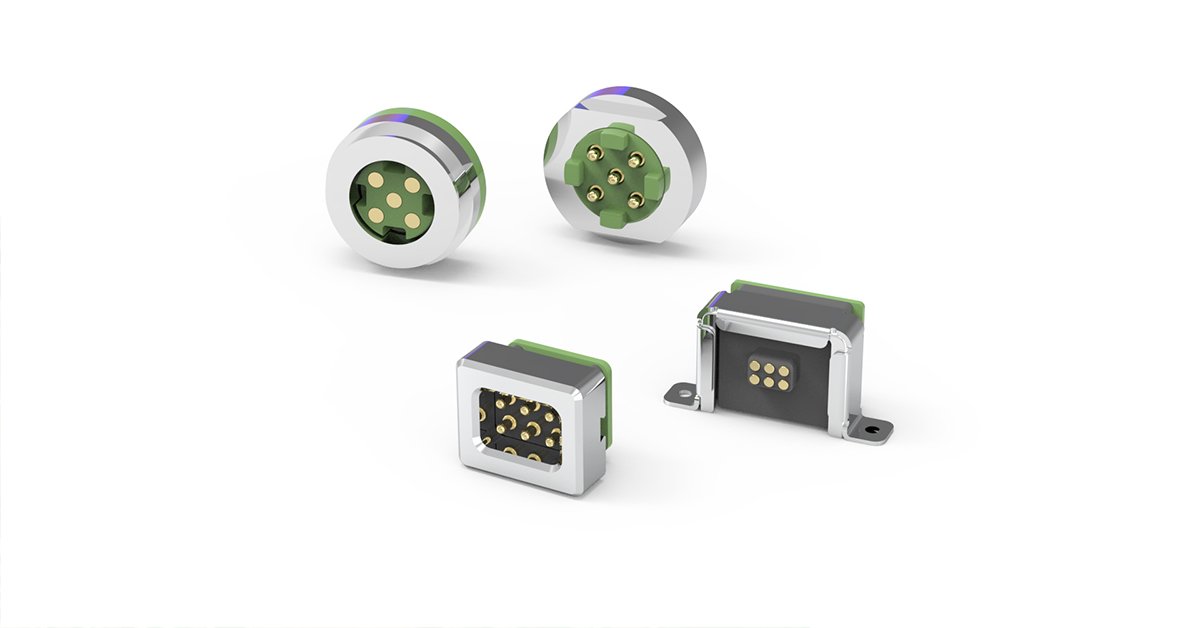
A pogo pin housing is the molded plastic body that holds each spring-loaded pin at a fixed position, spacing, and height. It looks passive. It is not. If the housing moves by a few hundredths of a millimetre, the pin tips no longer meet the mating pads evenly, and contact pressure changes from pin to pin.
That matters most in the high-current work this site focuses on. When several pins share a load, one pin sitting slightly proud takes more than its share of current and runs hotter. The working height you design around is partly a plastic property. Heat, moisture, and molding stress all change it over time.
The housing also does three other jobs at once:
- It electrically isolates neighboring pins, so spacing and tracking resistance matter.
- It survives assembly, including reflow soldering for SMT parts.
- It supports the seal in waterproof designs, either as the sealing surface itself or as the frame around an overmold, gasket, or potting.
When a connector fails in the field, buyers often blame the pin or the plating. In practice, a good share of those cases trace back to housing movement, moisture effects, or a seal that the plastic could not hold. For the other common causes, see our guide on why pogo pins fail.
LCP vs. High-Temp PA at a Glance
LCP is a rigid, glass-filled or mineral-filled thermoplastic whose molecules line up in the mold, which gives it high stiffness, very low shrinkage, and excellent flow into thin walls. High-temp PA is a family of heat-resistant nylons designed to survive lead-free soldering temperatures where ordinary PA6 or PA66 would soften.
The figures below are typical ranges. They vary by grade and filler, so treat them as a way to frame the conversation and check the datasheet of the actual resin.
| Property | LCP (glass-filled) | High-temp PA (PA46, PA6T, PA9T) |
|---|---|---|
| Heat tolerance | Very high; handles lead-free reflow with margin | High, but closer to the limit at peak reflow |
| Moisture absorption | Very low | Noticeably higher; varies widely by type |
| Dimensional stability | Excellent; low warpage | Good when dry; shifts as it absorbs water |
| Thin-wall molding | Excellent flow for fine pitch | Good, usually with thicker walls |
| Toughness and weld lines | Stiff but can be brittle; weld lines are weak | Tougher; more forgiving of impact |
| Material cost | Higher | Lower |
If you only remember one line from this article, make it this one: LCP buys you stability and precision, while high-temp PA buys you toughness and a lower price.
Reflow Heat: Where Housings Get Tested First
Surface-mount pogo pins and pogo pin connectors go through a reflow oven, and lead-free solder profiles typically peak somewhere around 240 to 260°C. Plastic that cannot take that heat softens, blisters, or warps, and a warped housing means pins that no longer sit flat on the pads.
LCP handles this comfortably. Its melting range sits well above reflow temperatures, and its low moisture content means there is little water to flash into steam inside the part. That is why LCP is so common in fine-pitch SMT/SMD pogo pins.
High-temp PA can also pass reflow, which is the whole point of the PA46, PA6T, and PA9T grades. The catch is moisture. Polyamides absorb water from the air, and a damp housing heated fast can blister or lose dimensional accuracy. Parts need controlled storage and sometimes baking before reflow. If your factory has loose humidity control, that is a real risk, not a footnote.
Here is a practical way to think about it. If your assembly line is clean, dry, and well-controlled, high-temp PA is workable. If you build in a humid region, ship loose reels for long periods, or run aggressive profiles, LCP removes a whole category of process risk. Tell your supplier your peak reflow temperature and your storage conditions so the resin is chosen against your actual line, not an assumed one.
Also note that reflow only matters for SMT mounting. A DIP pogo pin that is hand- or wave-soldered sees a different, shorter heat exposure, which can widen your material options.
Moisture, Swelling, and Long-Term Stability
This is where the two materials separate most clearly. LCP absorbs almost no water, so its dimensions barely change between a dry warehouse and a wet bathroom. High-temp PA absorbs more, and as it does, it swells slightly and its stiffness drops.
How much depends on the polymer. PA46 takes up the most water of the group. PA6T and PA9T are formulated to absorb less, which is a large part of why they exist. None of them match LCP here.
For a pogo pin housing, small swelling can matter in three ways:
- Pin position drifts slightly, which changes spring compression and contact force.
- Press-fit or snap features loosen or tighten, which affects retention.
- Seal compression changes, because the surface your gasket or overmold relies on is no longer the size you designed.
That last point is the one that surprises people. A seal that tests perfectly on dry parts can leak after weeks of humidity if the plastic around it has moved. A cleaner design leaves room for that movement, or chooses a resin that does not move at all.
Hot water, steam, and certain chemicals add another layer. Polyamides can degrade through hydrolysis when exposed to hot water or glycol for long periods, and some are attacked by salt solutions. LCP resists a wide range of solvents and fuels. If your product sees engine coolant, salt spray, or repeated hot washdowns, ask for chemical resistance data on the exact grade. Our article on salt spray testing for pogo pins explains how corrosion testing is usually structured.
Sealing and Waterproof Performance
A waterproof rating describes the finished assembly, not a loose part. The housing is one piece of that assembly, and it supports sealing in different ways depending on the method.
| Sealing approach | What the housing must do | Material note |
|---|---|---|
| Sealed plunger inside the pin | Hold the pin barrel steady so the seal sees even friction | Stability helps; either resin works if the bore stays true |
| Overmold or potting around the body | Bond or mechanically lock to the sealing compound | Surface finish and adhesion vary by resin; test the combination |
| Face gasket against the product wall | Stay flat and hold its shape under gasket pressure | LCP resists creep and warping; PA needs moisture allowance |
The point is that sealing is a system. A housing in LCP does not make a connector waterproof, and a PA housing does not make it leak. What matters is whether the plastic holds its shape and surface under the sealing method you chose, across your temperature and humidity range.
When you read a rating, remember where it comes from. IP codes are defined in IEC 60529, and the difference between temporary and continuous immersion is spelled out in the IEC guide to IP ratings. A claim without a stated depth and duration is hard to compare.
For waterproof pogo pins, CFE lists the BP77031 as its standard part and states that other waterproof inner structures can be developed. Because every seal fights the spring, the housing, seal, and spring are best designed together. Browse the waterproof pogo pin range and ask engineering which housing and sealing method a given part uses. The product pages we reviewed do not state the housing resin, so confirm it directly rather than assuming.
Strength, Impact, and Weld Lines
Stiffness is not the same as toughness, and housings need both. LCP is very stiff and holds precise shapes, but it is also anisotropic: its molecules orient in the direction the plastic flows, so strength differs along and across the flow. Where two flow fronts meet in the mold, called a weld line, LCP can be notably weaker.
That weakness is manageable with good gate placement and by keeping thin features away from weld lines, but it is why a drop test sometimes cracks an LCP housing that looked robust on paper. Buyers of rugged products should ask where the weld lines fall and whether the part has been drop-tested as an assembly.
High-temp PA is the tougher material. It absorbs impact better, tolerates snap-fits and press-fits, and keeps useful strength at weld lines. For larger housings, multi-pin blocks, or products that get dropped, thrown in bags, or docked a thousand times, that toughness is a real advantage.
Vibration deserves its own mention. In automotive and industrial uses, brittle fracture of a small LCP wall is a more realistic failure than creep. In a magnetic connector, where the housing also carries the magnet pocket, the plastic sees repeated attraction and separation forces. Our 5–30A magnetic connectors are a good reference for how those loads show up in practice.
Electrical Safety, Flame Rating, and High Current
At 5A to 30A, the housing sits right next to heat. A pin carrying real current warms the plastic around it, and the plastic must stay stable at that temperature for years. Continuous service temperature is a different number from the short reflow peak, so ask for both.
Electrical insulation is not equal across grades. Look at three items on the datasheet:
- Comparative tracking index (CTI): how well the surface resists conductive tracking when contaminated. It matters when pin spacing is tight and moisture or dirt is likely.
- Flame rating: many electronics customers require a UL 94 V-0 grade. Confirm the rating applies at your wall thickness.
- Dielectric strength and volume resistivity: both should leave comfortable margin at your voltage.
Heat from the pin also depends on what surrounds the connector. A thin trace or poor copper design can make the housing run hotter than the pin alone would suggest. We covered that in PCB design for 30A pogo pins, and it is worth reading before you finalize a high-current layout.
One more practical note: if the pin tips and plating matter to your contact resistance, the plastic cannot fix a poor finish. Read Pogo Pin Gold Plating: Microinches vs. Microns alongside this guide, since the best housing in the world cannot save a worn contact.
Cost, Supply, and Tooling Reality
LCP resin costs more per kilogram than high-temp PA, and its tooling can be pricier because it needs precise gating and venting to avoid weld-line problems. In fine-pitch parts where the plastic weight is tiny, the resin premium is often a small share of the connector price, and the stability gain is worth it. In larger housings, the cost gap grows and PA becomes more attractive.
Supply is the other half. Both materials come from a handful of major resin makers, and a specific grade can be scarce or on long lead times. Ask whether your supplier has an approved alternative grade, because a last-minute resin swap changes shrinkage, and shrinkage changes pin spacing. Changing resin usually means changing or re-qualifying the tool.
Volume also changes the math. A custom connector that starts as a prototype may move to production tooling, and material choice affects both cycle time and scrap. Share expected annual volume early, as it influences which resin is realistic. For custom builds, start from the custom pogo pin connector page.
How to Choose: A Simple Decision Guide
| If your project has… | Lean toward | Reason |
|---|---|---|
| Fine pitch (about 1.27 mm and below) and SMT reflow | LCP | Thin walls, low warpage, heat margin |
| Humid storage or long wet exposure | LCP | Almost no moisture swelling |
| Larger multi-pin body, rough handling, drop risk | High-temp PA | Better toughness and weld-line strength |
| Tight unit cost on a bigger housing | High-temp PA | Lower resin cost |
| Hot water, glycol, or salt exposure | LCP, or verified PA grade | Chemical resistance varies; demand data |
| Hand-soldered DIP mounting only | Either | Reflow limits do not apply |
Treat this as a starting point, not a verdict. A real design usually has one dominant constraint, such as reflow or sealing, and that constraint should decide the material.
What to Send Your Supplier
Buyers get faster, more accurate quotes when the housing requirements are written down. Include these items in your request:
- Mounting method (SMT, DIP, right-angle, solder cup) and your peak reflow temperature
- Continuous operating current, peak current, and acceptable temperature rise
- Water and chemical exposure, with depth and duration for immersion
- Storage conditions and humidity during transport and assembly
- Drop, vibration, or insertion-force requirements
- Flame rating and any customer or regional compliance requirements
- Expected annual volume and target launch date
Then ask three questions in return: which exact resin grade is used, what its continuous service temperature is, and whether an approved alternate exists. A supplier who answers all three clearly usually understands the product.
If you are developing a sealed 5A–30A design, start from the waterproof pogo pin and magnetic connector guide, review the CFE quality process, and then request a quote and samples with your housing requirements included.
Frequently Asked Questions
Is LCP better than PA for pogo pin housings?
Not always. LCP is better for fine-pitch, SMT, and moisture-sensitive designs because it stays dimensionally stable and handles reflow with margin. High-temp PA is better when you need toughness, lower cost, or a larger housing. The right answer depends on your reflow profile, sealing method, and handling conditions.
Can high-temp PA survive lead-free reflow?
Yes, grades such as PA46, PA6T, and PA9T are designed for it. The main risk is absorbed moisture, which can cause blistering or warping if parts are stored damp. Keep housings dry and follow the supplier’s storage and baking guidance.
Why does moisture matter for a waterproof connector?
Because absorbed water swells some plastics slightly, and that can change pin position and seal compression. A seal that passes on dry parts can behave differently after long humid exposure. LCP absorbs very little water, which is why it is common in sealed, fine-pitch designs.
How do I know which resin a connector uses?
Ask the supplier for the exact resin grade and datasheet, not just “LCP” or “nylon.” Both names cover many materials with different heat, moisture, and flame properties. Request continuous service temperature and flame rating as well.
Does housing material affect current rating?
Indirectly, yes. The pin carries the current, but the housing must tolerate the heat it produces for years. Contact resistance, PCB copper, and duty cycle decide the temperature rise, and the plastic needs a continuous service rating above it.
Send your requirements to the CFE engineering team for a recommendation that fits your connector, environment, and production line.