Electric vehicles don’t just run on batteries — they run on connections. Every time a car docks with a charger, a robot arm mates with a tool head, or a battery-swap station locks onto a pack, a tiny spring-loaded contact is doing the heavy lifting behind the scenes. That contact is usually a pogo pin, and when the current climbing through it reaches double digits, “high-current” stops being a marketing label and becomes an engineering requirement.
If you’re sourcing connectors for an EV charging product — a charging dock, a battery module, a swap station, or a test fixture — this guide walks through exactly what to look for before you commit to a supplier or a part number.

What Makes a Pogo Pin Connector “High-Current”?
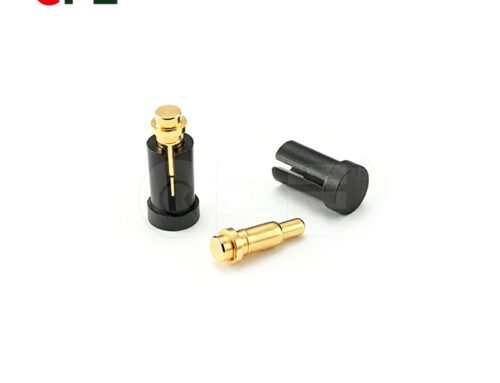
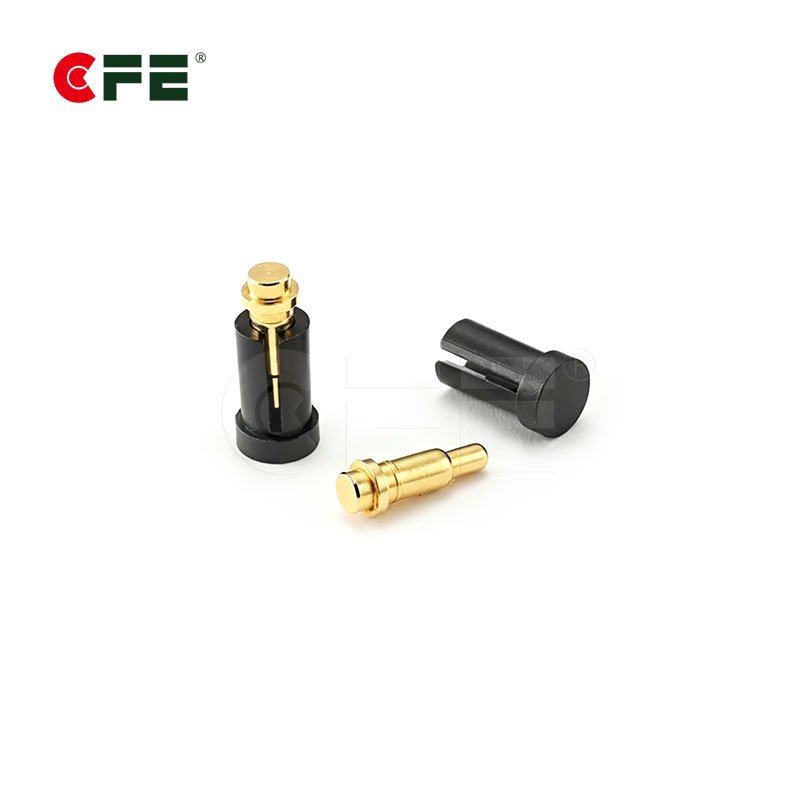
A standard pogo pin is built from three parts: a barrel, a plunger, and a spring. In most consumer electronics, that assembly carries a few hundred milliamps to a couple of amps — enough for signal or low-power charging. A high-current pogo pin connector is re-engineered at every one of those three points so it can carry sustained loads of 5A, 15A, 30A, or more without the contact overheating, the plating degrading, or the spring losing tension over thousands of cycles.
The differences usually come down to:
- Larger barrel diameter and plunger cross-section to lower resistance and spread heat
- Higher-conductivity base metals (beryllium copper or brass alloys) instead of standard copper alloys
- Heavier gold or silver plating to keep contact resistance low over the connector’s life
- Reinforced springs rated for higher normal force, so contact pressure — and therefore conductivity — stays stable under vibration and repeated mating
None of this is optional in an EV context. A pin that’s “close enough” on paper can still cause voltage drop, localized heating, or premature failure once it’s actually carrying charging current in the field.
Why EV Charging Applications Demand High-Current Pogo Pins
EV charging systems are one of the most demanding environments a spring-loaded connector will ever see, for a few reasons:
- Sustained current, not a burst. Charging sessions run for minutes to hours, so the pin has to dissipate heat continuously rather than in short pulses.
- Frequent mating cycles. A charging dock or swap connector may be plugged and unplugged dozens of times a day, which adds up to tens of thousands of cycles over a product’s lifetime.
- Harsh operating conditions. Charging hardware is often outdoors or semi-exposed, so connectors also need to handle temperature swings, moisture, dust, and vibration — which is why waterproof, IP-rated pogo pin housings are increasingly standard on EV-adjacent products.
- Safety margins. Overheating at a power contact isn’t just a performance issue; it’s a safety issue. Buyers need documented current ratings with real derating data, not just a number on a spec sheet.
Key Buying Criteria for High-Current Pogo Pin Connectors
When you’re comparing suppliers or part numbers, run through this checklist:
Rated current and derating curve. Ask for the actual current-vs-temperature-rise curve, not just a headline “30A” figure. Real-world current capacity depends on ambient temperature, duty cycle, and how the pin is mounted.
Contact resistance. Lower is better. High-current designs should hold contact resistance well under 50 mΩ across the rated cycle life, since resistance is what turns current into unwanted heat.
Spring force and cycle life. Higher normal force generally means better conductivity but faster wear, so look for connectors independently rated for 10,000–100,000+ mating cycles at the spring force your application needs.
Plating and base material. Gold plating over nickel is the industry default for corrosion resistance and low resistance; thicker gold (measured in micro-inches) generally means a longer service life in outdoor or high-cycle applications.
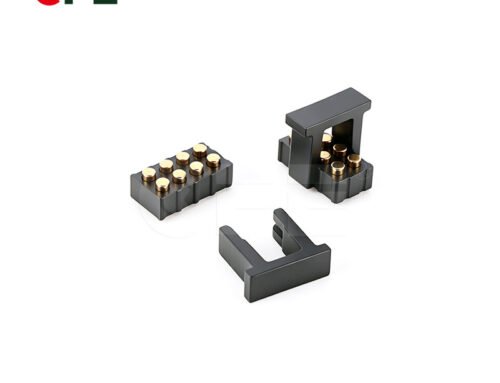
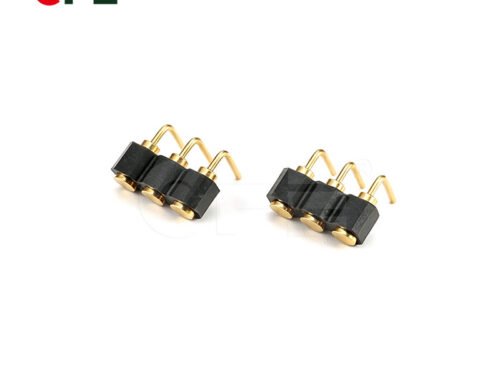
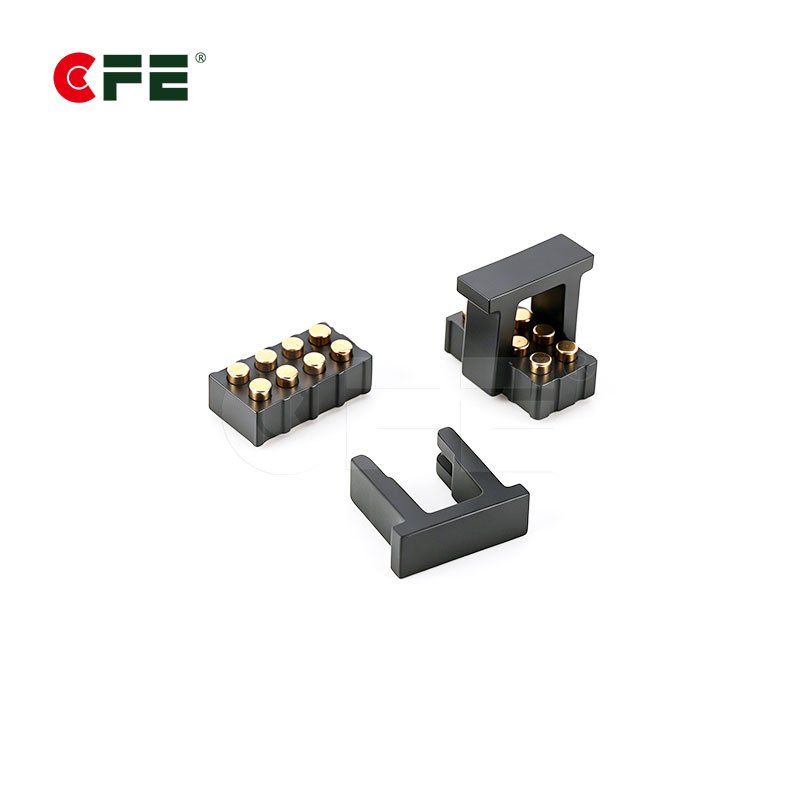
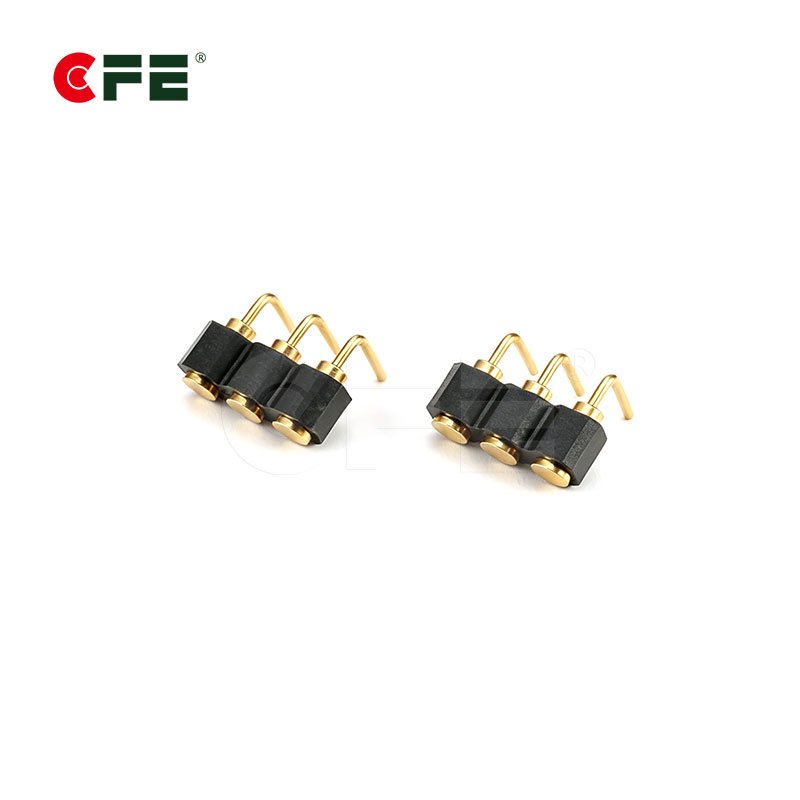
Mounting style. High-current pogo pins ship in several mounting formats — SMT/SMD for reflow assembly, through-hole/DIP, solder cup for manual wiring, and right-angle for space-constrained enclosures. The right format depends on your PCB layout and assembly process.

Sealing and IP rating. For any connector exposed to weather — outdoor charging posts, battery-swap stations, vehicle-mounted docks — confirm the IP rating (IP67/IP68 where relevant) and ask how it’s achieved: overmolding, O-rings, or potting.
Certifications and quality system. For automotive-adjacent hardware, supplier certifications matter as much as the part drawing. Look for ISO 9001, IATF 16949, and RoHS/REACH compliance documentation before you qualify a vendor.

Common Applications Beyond the Charging Cable
High-current pogo pins aren’t limited to the plug you hold in your hand. They’re also used in:
- Battery-swap stations, where a connector needs to make and break a high-current connection automatically, thousands of times, with no wear-related drift
- Charging docks for e-bikes, e-scooters, and light EVs, where compact size and high current have to coexist
- Test and burn-in fixtures, where engineers need a durable, low-resistance probe to validate battery packs and power electronics before they ship
- Robotics and automated charging systems, where a robot arm or AGV docks itself to a charging point without a human plugging anything in
In every one of these cases, the pogo pin is a wear part that’s expected to behave like a permanent connection — which is exactly why current rating, cycle life, and plating quality can’t be an afterthought.
How to Choose the Right Supplier
A datasheet only tells part of the story. Before you finalize a connector for an EV charging design, it’s worth asking a supplier for:
- Sample parts for in-house current and temperature-rise testing
- Documented cycle-life test data at your target spring force
- Customization options if a standard part doesn’t fit your pitch, stroke, or current requirement
- Evidence of relevant quality certifications for automotive and safety-adjacent components
Suppliers who specialize in high-current pogo pin connectors built specifically for demanding power applications — rather than repurposing a signal-grade pin — are generally a safer long-term bet for EV charging hardware, since the entire pin geometry and plating spec are already optimized for sustained current rather than adapted after the fact.
It’s also worth checking how a connector’s rated current compares against the charging standard your product needs to support. Level 2 AC charging under the SAE J1772 standard can call for continuous current well into double digits, so the connector’s real-world derated rating — not just its peak spec — needs headroom above your system’s actual draw.
Conclusion
Choosing a high-current pogo pin connector for an EV charging product isn’t just about matching an amperage number on a spec sheet. It’s about verifying contact resistance, cycle life, plating quality, sealing, and certifications together — because in a charging application, any one weak link can turn into a heat problem, a reliability problem, or a safety problem. Working with a manufacturer that designs pogo pins specifically for high-current, high-cycle use, and that can back up its ratings with real test data, is the most reliable way to avoid costly redesigns once a product is already in the field.
FAQs
Q1: What current can a high-current pogo pin connector actually handle?
Depending on pin diameter, spring design, and plating, high-current pogo pins typically range from 5A to 30A per pin, with some heavy-duty or multi-pin designs rated higher. Always check the manufacturer’s derating curve rather than relying on a single headline number.
Q2: How is a high-current pogo pin different from a standard pogo pin?
High-current pins use a larger barrel and plunger, heavier-duty springs, and thicker plating to keep contact resistance and heat generation low under sustained load — standard pogo pins are optimized for signal or low-power charging, not continuous high current.
Q3: Do EV charging pogo pins need to be waterproof?
For any connector exposed to outdoor conditions — charging posts, swap stations, vehicle-mounted docks — an IP67 or IP68 rating is strongly recommended to prevent moisture and dust from affecting contact resistance over time.
Q4: How many mating cycles should a high-current pogo pin survive?
Most industrial and EV-grade pogo pin connectors are rated between 10,000 and 100,000+ mating cycles, depending on spring force and application. Automated docking applications like battery swapping typically need the higher end of that range.
Q5: What mounting style should I choose — SMT, DIP, solder cup, or right-angle?
It depends on your assembly process and enclosure layout: SMT suits reflow-soldered PCBs, DIP/through-hole suits manual or wave soldering, solder cup suits hand-wired connections, and right-angle pins suit space-constrained or side-entry designs.