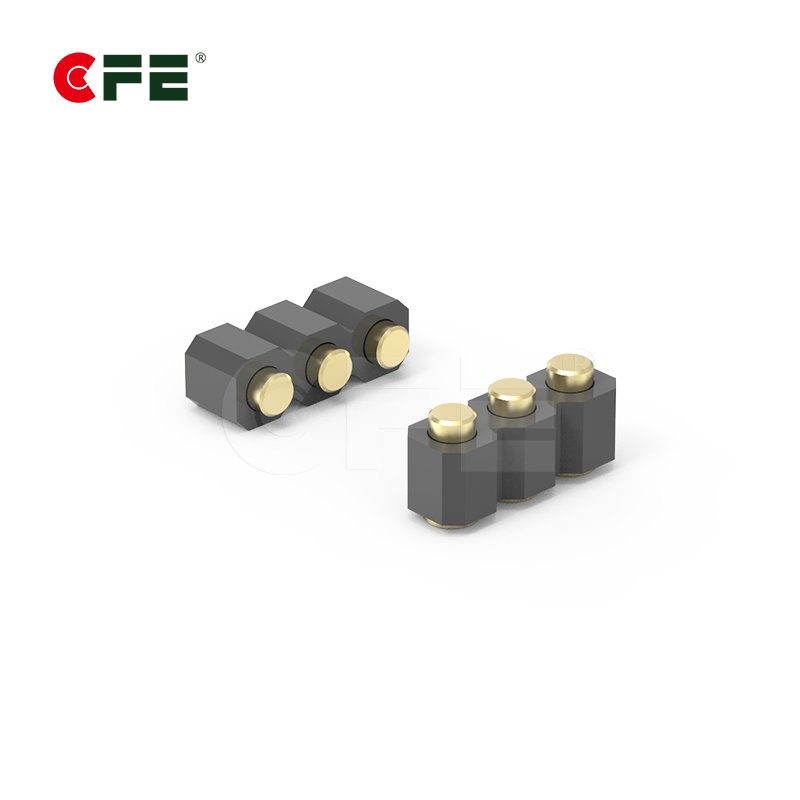
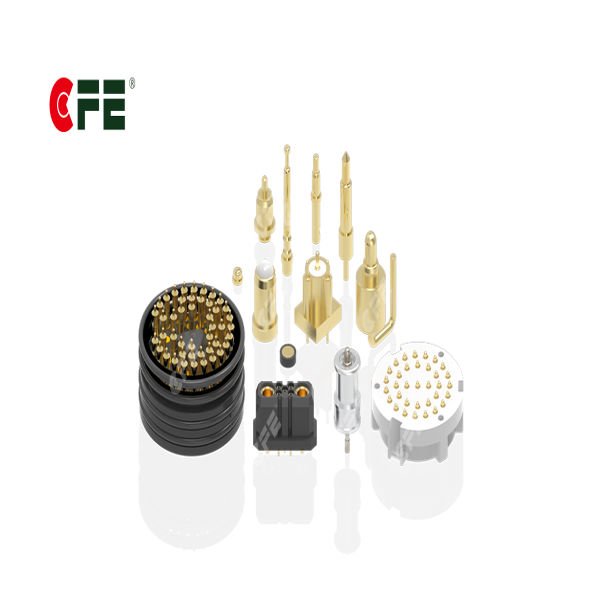
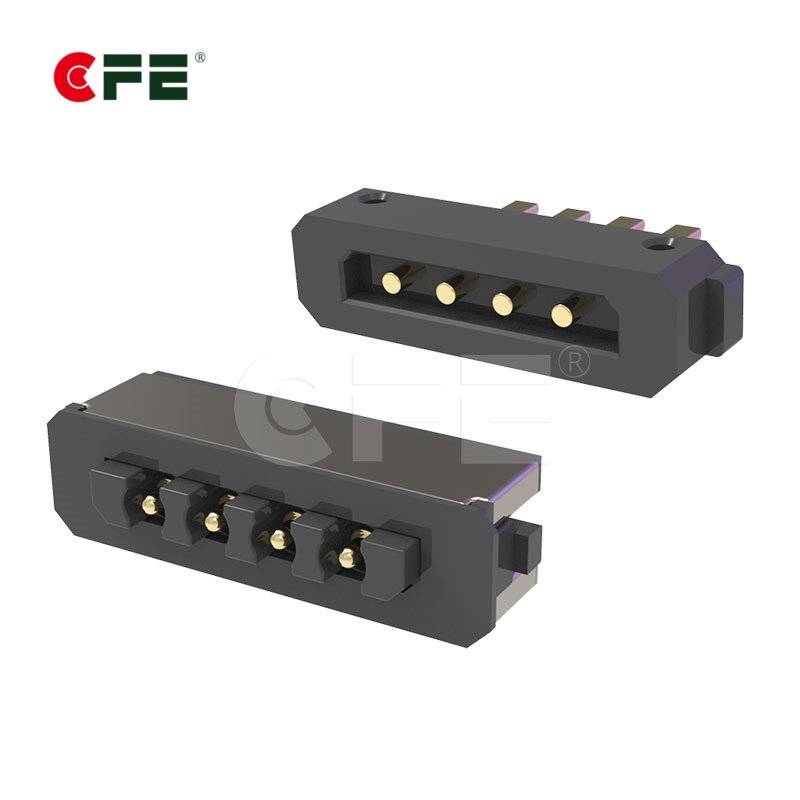
Non-magnetic pogo pins for medical devices are spring-loaded contacts built only from materials with very low magnetic susceptibility, so they neither distort an MRI image nor get pulled by the scanner’s magnet. That is the short answer. The longer one is where procurement teams get caught out: a pin can be made of “non-magnetic” brass and still fail, because the spring, the plating or a trace of iron quietly brings the magnetism back.
If you buy connectors for patient monitors, wearable sensors or equipment that sits near an MRI suite, this guide walks through every material in a pogo pin, shows where the hidden magnetic risks live, and lists what to write into an RFQ so the claim is backed by evidence. For the wider view of what CFE supports in healthcare, see our medical connector solutions page.

What non-magnetic really means for a pogo pin
Magnetism in a metal part is described by its magnetic susceptibility. Iron and nickel are strongly attracted to a magnet. Copper, brass, gold and silver barely respond at all; they are weakly repelled. Published materials tables put nickel and copper orders of magnitude apart, which is why one nickel layer inside an otherwise copper-alloy pin matters more than most engineers expect.
Regulators do not certify a loose pin as “non-magnetic”. Instead, ASTM F2503 defines three marking terms for items used in the magnetic resonance (MR) environment: MR Safe, MR Conditional and MR Unsafe, and the FDA guidance on testing and labeling medical devices for MR safety builds on them. Those labels belong to the finished device. ASTM’s overview of the standard explains the three icons that clinical staff look for at the scanner room door.
What does that mean for a connector buyer? A supplier cannot sell you an “MR Safe pin”. What the supplier can give you is a documented material stack and measured data that let your device pass its own assessment. Treat the connector as evidence you collect, not a badge you buy.
Where medical designs actually need non-magnetic contacts
The requirement shows up when a device enters, or sits close to, the MR environment: MR Conditional patient monitoring, coil interfaces, accessories used inside the scanner room, and sensor modules that measure magnetic fields themselves. Most MRI systems run between 1.5 and 3 tesla, a range quoted by Times Microwave in its guide to truly non-magnetic connectors. At that strength, a small ferromagnetic part can feel real force, and even a weakly magnetic one can distort the image.
There is also an image-quality angle. ASTM F2503 treats image artifact separately from safety, but radiologists care about it, and a contact that bends the local field can leave a visible shadow near the anatomy being scanned.
Just as important, many medical devices never need this. Home blood pressure monitors, glucose meters, oximeters and ear thermometers, the wearable categories listed on CFE’s medical page, normally stay outside the scanner room. Specifying non-magnetic materials for them adds cost and lead time for no benefit. Define the intended-use environment first, then decide.
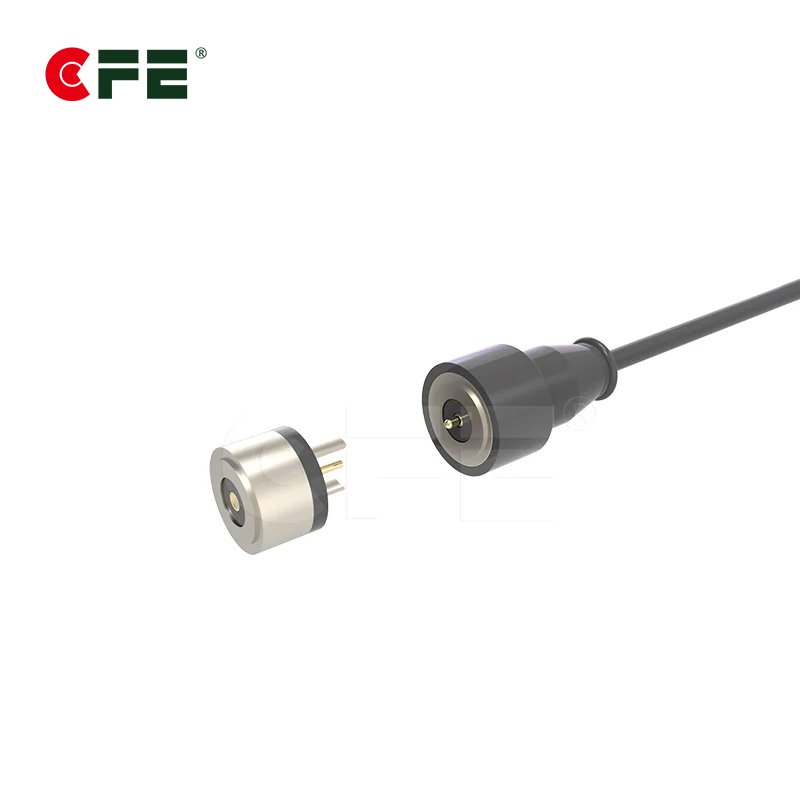
Magnet-retained is a different category. Connectors that use magnets to align and hold, such as the charging connector on CFE’s portable ECG tester page, suit devices that stay out of the MR environment. If your device has to enter it, a non-magnetic pogo pin interface is the route to evaluate.
Every layer of a pogo pin is a decision
A pogo pin looks simple, but it is an assembly of metals and plastics, and the magnetic result is only as good as the weakest layer. Use this table as a first-pass audit of any datasheet.
| Component | Typical material | Magnetic risk | What to specify |
|---|---|---|---|
| Plunger and barrel | Brass, phosphor bronze or other copper alloy | Iron-bearing grades or contamination raise susceptibility | Named alloy grade plus mill certificate |
| Spring | Music wire or stainless steel in standard builds | Carbon steel is ferromagnetic; cold-worked stainless can turn weakly magnetic | Beryllium copper or phosphor bronze wire |
| Underplate | Nickel, the usual diffusion barrier | Nickel is ferromagnetic | Non-nickel barrier, or a verified non-magnetic nickel-phosphorus layer |
| Top plating | Gold | Gold is diamagnetic and not a concern | Thickness and gold type for wear and contact resistance |
| Housing | LCP, high-temp PA or similar plastic | Plastic is non-magnetic; fillers, inserts and pigments need checking | Confirm no metal inserts or magnetic additives |
| Tail and termination | SMT, DIP or solder cup | Tail plating and solder finish can add nickel | Declare the finish on the tail as well as the contact tip |

Base metals: brass, phosphor bronze and beryllium copper
Brass is the workhorse of the pogo pin world. It machines cleanly, costs less and conducts well. It is non-magnetic when the alloy is free of iron-bearing impurities, so ask for the grade and a certificate rather than accepting “brass” on a drawing.
Phosphor bronze gives you better spring behavior and corrosion resistance, at the cost of lower conductivity than brass or pure copper. It is a sensible choice for barrels and springs where cycle life matters more than peak current.
Beryllium copper (BeCu) pairs high strength with good conductivity, and it is non-magnetic and non-sparking, as materials supplier Materion notes in a connector roundup. That is why it appears so often in MRI-grade connectors. The trade-off is cost, and beryllium-bearing alloys call for controlled machining and clear handling documentation, so ask your supplier how they manage both.
Whichever alloy you pick, pair it with the right housing. Our guide to pogo pin housing materials, LCP versus high-temp PA covers the plastic side, and the comparison of a pogo pin versus a spring contact helps if you are still choosing a contact style.
The spring is usually the weak link
Standard pogo springs are often wound from steel music wire or stainless steel because both are strong and inexpensive. Carbon steel is ferromagnetic, so a single steel spring inside a brass pin defeats the whole exercise. Even austenitic stainless, normally treated as non-magnetic, can become partly magnetic after cold working and machining; Times Microwave makes the same point about connectors in its guide.
Beryllium copper and phosphor bronze springs avoid the problem, with trade-offs. Fine BeCu wire is thin, and a PRECI-DIP tutorial hosted on DigiKey notes that holding contact resistance low through shock and vibration can be difficult in some spring-pin designs. The practical lesson: test contact resistance and force on your actual assembly. The approach is proven in demanding settings; Smiths Interconnect reports non-magnetic spring probes for MRI-for-mri-applications/) with mating cycles above sixty thousand.
Plating: the hidden nickel problem
Here is the detail that surprises most buyers. Standard pogo pins are commonly plated gold over nickel. As our pogo pin gold plating guide explains, nickel acts as a barrier so copper and zinc from the brass base cannot migrate to the surface and tarnish the contact. It is excellent engineering for ordinary electronics. For an MRI-adjacent device, it puts a ferromagnetic layer on your pin.
You have a few options to discuss and validate with samples:
- Gold over a non-nickel barrier layer on a copper-alloy base.
- Gold over a non-magnetic nickel-phosphorus layer, an approach some RF connector makers describe, with the phosphorus content specified and verified.
- Thinner underplating where wear and corrosion targets allow, remembering that less ferromagnetic material means less effect, not zero effect.
Which route fits depends on corrosion, wear and cycle-life targets, so do not assume. Measure the finished part. Fairview Microwave advises avoiding nickel in non-magnetic builds, while Radiall describes using non-magnetic nickel-phosphorus under gold. Both are fair starting points for your own specification.
Biocompatibility and skin contact
Charging contacts on a wearable can touch skin. The FDA’s biocompatibility endpoints for surface devices include cytotoxicity, sensitization and irritation for intact skin, following the framework of ISO 10993-1. Nickel is a well-known sensitizer, which gives you a second reason to reconsider a nickel-heavy stack.
Remember who owns the evaluation: your device, as a whole, not the component. Ask your supplier for material declarations and plating data that make your biological evaluation plan easier to write. A gold outer surface helps, but it does not replace the assessment.
Cleaning, sealing and disinfection
Medical devices get wiped, sprayed and washed, so contacts need to survive repeated cleaning. Sealing helps keep fluids out of the pin cavity; CFE’s waterproof pogo pin range lists ratings up to IPX8, and our explainer on whether pogo pins are waterproof covers what that rating does and does not promise.
Disinfectants can attack plating and plastics, so check compatibility against the specific agents your hospital customers use, and do not assume sterilization compatibility from a datasheet. For maintenance practice, see how to clean pogo pins.

How to verify a non-magnetic claim
A datasheet line that says “non-magnetic” is a starting point, not proof. Work through these steps before you freeze a design.
- Define the environment. Write down field strengths, the location relative to the scanner, and who owns device-level MR labeling.
- Demand a layer-by-layer declaration. Base alloy grade, spring wire, underplate, top plate and thickness, plus the tail finish.
- Ask for data on finished parts. Raw stock can pass while machined and formed parts do not, so measured results on the real pin matter.
- Run a quick magnet screen. A strong hand magnet near a sample batch catches obvious problems. It is only a screen and says nothing about heating or image artifact.
- Test at device level. Follow the FDA guidance for the hazards that apply to your product, such as force, torque, heating and artifact.
- Lock the specification. Put material notes on the drawing, require lot traceability, and add a clause that any change in material or plating needs written approval.
What to put in your RFQ
A precise request saves weeks of back and forth. Include the following, and your supplier can tell you quickly whether they can meet it.
| RFQ item | What to state |
|---|---|
| Intended environment | Outside, near or inside the MR environment, with field strength |
| Material stack | Allowed alloys, spring wire, plating layers and thickness range |
| Prohibited materials | Nickel or steel anywhere in the contact path, unless verified otherwise |
| Electrical and mechanical needs | Current, contact force, stroke and cycle-life targets |
| Documentation | Material certificates, plating reports and measured magnetic data on finished parts |
| Change control | Written approval for any material or process change |

Working with CFE on medical connection projects
CFE’s medical page lists ISO 13485 certification, a Class II medical device manufacturing license and compliance with FDA standards, and the quality and certification pages give more background. Our standard pogo pin builds use brass with gold over nickel, so a non-magnetic version is a custom specification that we would confirm with you in writing and validate on samples before any commitment.
If you have a drawing, start with our custom pogo pin connector options or browse the full pogo pin range. When you are ready to talk specifications, send us your requirements and the engineering team will review the material stack with you.
Conclusion
Non-magnetic pogo pins for medical use come down to discipline, not a single material. Choose copper-alloy bodies, keep steel springs out, question every nickel layer, and demand evidence on the finished part. Match the specification to the real environment so you do not overpay when MRI is not in play, and remember that MR labeling belongs to your device. Do that, and your connector supplier becomes a source of proof rather than promises.
Frequently asked questions
Are all gold-plated pogo pins non-magnetic?
No. Gold itself is not magnetic, but it is only the top layer. A nickel underplate or a steel spring beneath it can still make the pin magnetic.
Can a pogo pin carry an MR Safe label?
The MR Safe, MR Conditional and MR Unsafe terms apply to finished devices and items. A pin supports your device-level assessment through material and test data but is not labeled on its own.
Which material is best for non-magnetic pogo pins?
There is no single best. Brass, phosphor bronze and beryllium copper are the usual non-magnetic choices, and the right one depends on current, cycle life, cost and plating compatibility.
Do home medical monitors need non-magnetic pins?
Usually not, because they stay outside the MR environment. They do need them if the device could enter the scanner room or contains sensitive magnetic sensing, so check the intended use.
How do I test whether a pogo pin is truly non-magnetic?
Start with a layer-by-layer material declaration and a magnet screen of sample pins, then confirm with measured data on finished parts and device-level testing under the FDA guidance.