An over-compressed pogo pin connector is a spring-loaded contact pushed past its rated working stroke. The internal spring can bottom out or lose force permanently, and the plunger and barrel can deform.
The result is intermittent connections, rising resistance, damaged mating pads, and a much shorter connector life. The sections below explain why it happens and how to prevent it.

What a Pogo Pin Actually Does
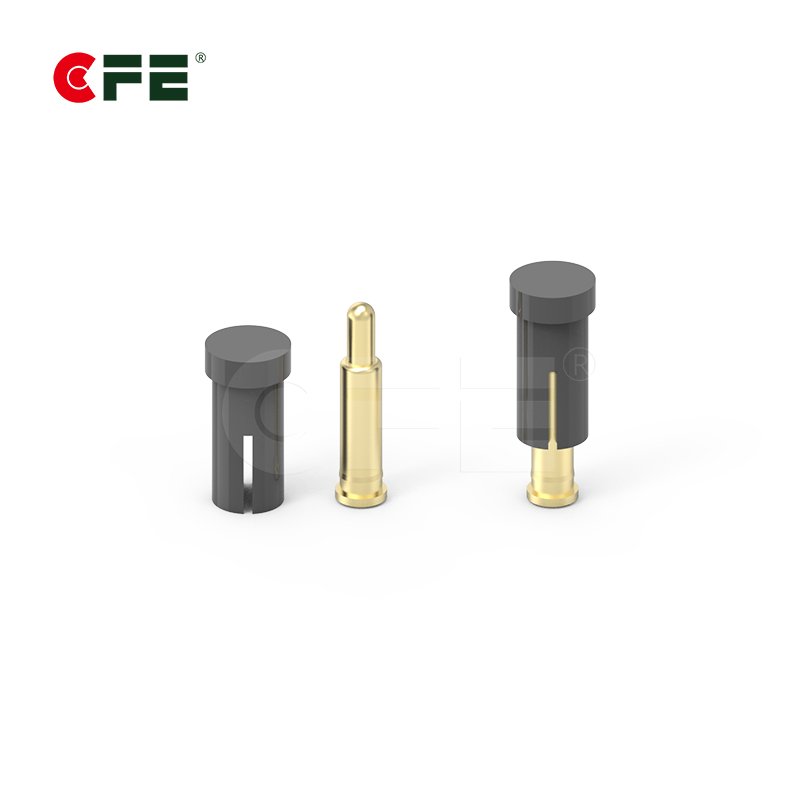
A pogo pin has three main parts: a barrel, a plunger, and a spring inside. When two surfaces meet, the plunger pushes into the barrel and the spring pushes back. That steady push keeps a clean electrical connection even when the device vibrates, expands with heat, or sits slightly crooked in its dock.
Think of it like a car’s suspension. It’s built to absorb bumps within a specific travel range. Push it past that range and you don’t get more comfort. You get a hard crash and, eventually, a broken part.
Every pogo pin datasheet lists two values that matter here:
- Full stroke: the maximum distance the plunger can physically travel.
- Working stroke: the recommended travel range in your product, usually well below full stroke.
Over-compression means going beyond the working stroke and, in the worst case, all the way to full stroke or past it.

What Happens Inside the Pin
When compression goes too far, damage tends to build in a predictable order.
-
The spring reaches solid height
Every coil spring has a point where the coils touch each other. Beyond it, the spring can’t compress any further, so extra force goes straight into the pin’s metal parts instead of being absorbed.
-
The spring takes a permanent set
Springs are designed to stay within their elastic range. Pushed past it, the wire yields slightly and doesn’t fully return to its original length. The pin now pushes back with less force than the datasheet promises, even after the overload is gone.
-
The plunger or barrel deforms
Hard bottoming-out, especially with a sideways load, can bend the plunger or slightly ovalize the barrel. The plunger then drags or sticks instead of sliding freely.
-
Plating wears faster
Pogo pins rely on thin gold over nickel for low, stable resistance. Higher force and more friction grind that layer down. Once the nickel is exposed, it oxidizes, and contact resistance climbs.
Warning Signs You Can Spot
Over-compression rarely announces itself with a dramatic failure. It creeps in. Watch for these:
- Intermittent charging or data dropouts, especially when the device is nudged
- A plunger that feels sticky, slow to return, or sits lower than neighboring pins
- Visible scuffing, dark spots, or flattened tips on the plunger
- Worn or discolored pads on the mating board, with gold rubbed through to a dull layer
- Warm connector housings during charging, a sign of rising resistance
- Failures that appear after extended use rather than in early testing
If you see any of these in returned units or lab samples, measure the installed compression before you blame the pin itself.
Effects at a glance
| Symptom | Likely cause | Practical impact |
|---|---|---|
| Weak or lost contact force | Spring took a permanent set | Intermittent connection |
| Plunger sticks | Bent plunger or deformed barrel | Contact doesn’t fully return |
| Rising resistance | Plating wear, oxidation | Heat, voltage drop, slow charging |
| Damaged mating pads | Excess contact force | Board or contact rework |
| Early cycle-life failure | Repeated bottoming-out | Field returns, warranty costs |

Why Over-Compression Happens in Real Products
It’s usually not one big mistake. It’s a stack of small ones.
- Tolerance stack-up
- Take an illustrative case: a pin with a 1.0 mm working stroke, designed for 0.6 mm of compression. If housing, PCB thickness, and assembly variation add up to ±0.3 mm, some units land at 0.9 mm or beyond. The drawing looks fine, but the worst-case unit isn’t.
- Missing hard stops
- If the mating parts can keep closing, they will. Without a mechanical stop, the pins take whatever force the user or the assembly applies.
- Side loading
- A dock that lets the device slide in at an angle pushes the plunger against the barrel wall, creating uneven wear and bending.
- Drop and shock events
- A sudden impact can drive a pin well past its working range in milliseconds, even if normal use never does.
- Over-tightened screws or clamps
- Crushing pins during assembly means damage before the product even ships.
Where This Problem Shows Up
Anywhere a product docks, charges, or connects again and again, contact force is tested every day. Stroke margins matter most in small wearables with tiny travel, handheld terminals that get pushed into cradles, and robots that reconnect to chargers on their own.


How Much Compression Is Safe?
Manufacturers publish their own limits, so the datasheet always wins. As a general engineering habit, designers aim for a working compression somewhere in the middle of the working stroke and avoid both extremes. Too little compression gives weak contact force. Too much accelerates wear and risks damage.
Design goal: even the worst-case tolerance combination stays inside the working stroke. If your worst-case unit touches full stroke, the design needs a fix, not just a better pin.
How to Prevent It
- Design a mechanical hard stop that limits travel before the pin reaches full stroke.
- Run a full tolerance analysis, including PCB thickness, housing, and assembly variation, at both extremes.
- Choose a pin with more stroke than you need, not exactly what you need.
- Guide the mating part with alignment features so it can’t approach at an angle.
- Use robust plating (thicker gold or an appropriate underplating) for high-cycle applications.
- Test beyond the spec: cycle, drop, and vibration testing on real assemblies, not only bench samples.
- Ask your supplier for stroke-versus-force curves and cycle-life data at your intended compression.
Mounting style is part of the stack-up
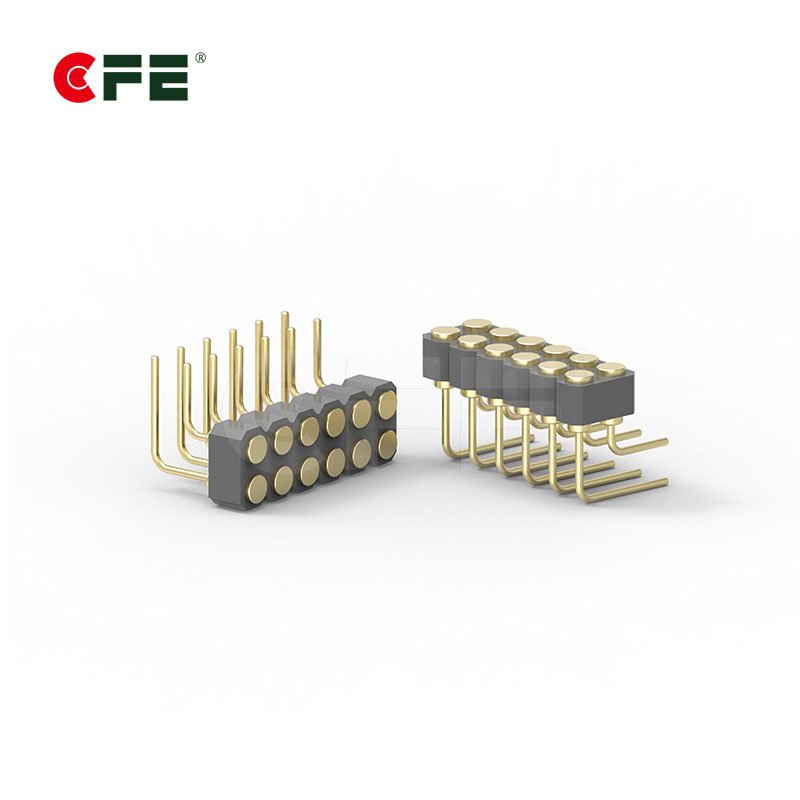
How a pin is mounted changes where it sits relative to the board and how the mating part closes onto it. Whether you choose surface-mount, through-hole, solder cup, or right-angle, measure your tolerance chain from the actual mounting datum.


What to Do If Pins Are Already Over-Compressed
- Don’t reuse them. A pin that has taken a permanent set won’t recover, and it will fail again.
- Inspect the mating pads for wear-through, and clean or rework them if needed.
- Measure installed compression on a sample of units and compare it against the datasheet’s working stroke.
- Look for the root cause in tolerances, missing stops, or assembly torque instead of only swapping parts.
- Re-validate with cycle and shock testing before releasing the fix.
Example Scenario: The Wearable Dock
Here is an illustrative example, not a specific customer case. A wearable charging dock uses pins with a 1.0 mm working stroke, designed for 0.6 mm of compression. Returned units show intermittent charging, and a teardown reveals worn pads and slightly shortened springs.
The cause turns out to be a thin housing tolerance plus users pressing the device down firmly to “make it click.” Adding a shallow hard stop and widening the alignment guide fixes it with no change to the pin itself. For applications that need a different geometry or stroke, CFE also offers a custom pogo pin connector approach. The fix often lives in the mechanical design rather than the component.
Standards and Supplier Proof
Check the relevant connector test standards, such as the IEC 60512 series and EIA-364 methods, which cover contact resistance and durability testing. Your supplier should be able to tell you which ones their data follows.
Also ask to see quality-system and compliance certificates, along with the test reports behind any cycle-life claim. Real data at your intended compression beats a headline number every time.

Conclusion
Over-compressing a pogo pin doesn’t usually cause an instant breakdown. It quietly weakens the spring, roughens the plating, and damages the mating surface until the connection becomes unreliable. The good news is that it’s almost entirely preventable: respect the working stroke, control your tolerances, add a hard stop, and test the way real users behave.
If you’re seeing unexplained intermittent contact, measure the installed compression first. It’s one of the fastest ways to find the real problem.
Frequently Asked Questions
Can an over-compressed pogo pin recover?
Sometimes a mild overload leaves the pin working, but any permanent spring set or bent plunger is irreversible. Replace pins that show reduced force or sticking.
What is the difference between full stroke and working stroke?
Full stroke is the maximum physical travel of the plunger. Working stroke is the recommended range for normal operation, and it’s always smaller.
Does over-compression cause overheating?
It can contribute. Worn plating and oxidized surfaces raise contact resistance, and higher resistance under current produces heat. For higher-power designs, see CFE’s high-current pogo pin selection guide.
How can I tell if my pogo pin is over-compressed?
Look for intermittent contact, a sticky or low-sitting plunger, scuffed tips, and worn mating pads. Measuring installed compression confirms it.
How do I prevent over-compression in a new design?
Add a mechanical hard stop, run worst-case tolerance analysis, pick a pin with spare stroke, and validate with cycle and shock testing.
Need help checking your compression margins?
Contact our engineering team for a design review of your stroke, tolerances, and hard-stop strategy and explore CFE’s pogo pin connector solutions.